Strategic Planning in Voluntary and Faith-Based Organisations
A Five Year Strategic Plan of Church of God Scotland


Introduction
This blog aims to investigate the Church of God Scotland’s growth plan designed to attach importance to strategy and Human Resources Management (HRM) as sustainability tools in a voluntary, faith-based organisation (Cavanagh et al., 2013; Fee & Gray, 2013). By definition voluntary, faith-based organisations include churches and other para church bodies that provide critical human and spiritual services (Placido and Cecil, 2014).
The report reviews the Church’s five-year strategic plan, which is aimed to be the most diverse Church in Scotland by 2023. Due to the environmental changes in the local and global business environments, no organisation, whether corporate or voluntary, can work well without adopting strategic planning (Belal and Abdullah, 2013). The Bible also teaches the importance of planning, (Proverbs 21.5, and Luke 14.28), yet religious organisations are likely to pay more attention to spirituality and faith than planning and management. Some believe that planning negates “living by faith” and considers it an affront to “divine direction.” During the launch of the Masters in Public Administration (MPA) programme to develop the leadership skill of religious leaders by Birmingham University, Dr A. Davies the programme leader argues that “In an uncertain and insecure world, people need competent, confident and clear leadership. They need faith leaders who are efficient, effective and ethical, who are as professional as they are personable” (Birmingham, 2020). Scotland’s demographic population has experienced a surge since the early 2000s (Scot.gov 2010). In light of this change, the Church of God has adopted a strategy to make its business fit into its environment (Campbell, 2011). As one of the fastest-growing and increasingly diverse churches in Scotland, the Church seeks to leverage its competitive advantage to be the most diverse Church in Scotland through effective management and strategic planning. This blog will look at the strategic plan of the Church concerning the strategic planning principles, her environment and competitors. It will also look at the organisation’s choice of strategy and evaluate the effectiveness of the strategy.
Strategic Planning
Strategic planning is an intentional, disciplined effort to produce fundamental decisions and actions that shape and guide what an organisation is, what it does, and why (Bryson, 2011). The idea has its historical roots in the military warfare strategy and later adopted by the private sector in the 1960s (Uwanbayingabire and Mulyungu, 2018). However, having a good strategic plan is good but seeing the plan through to implementation stage is great. For an organisation’s strategic plan to meet its set objective, it needs to implement an effective means of implementing the plan (Kimani, 2016). Preparation for strategic planning is as essential as the process itself; else failure is inevitable.
Strategic Management
Strategic management is a combination of decisions and actions that emanate from the formulation, implementation and evaluation of plans made concerning an organisation’s vision, mission, and environments within which the organisation operates (Kimani, 2016).
According to Thomson (2014),
Five questions all newly appointed Chief Executives should ask;
- What are the fundamental goals of the company?
- What is the strategy of achieving these goals?
- What are the fundamental issues facing the company?
- What is its culture?
- Is the company organised in a way to support the goals, issues and culture?
Strategic management aims to develop a continuing commitment to the value and the future dream of the organisation. It is designed to provide mechanics to hold all the crucial strands together maintaining a clear focus on the strategic agenda throughout the decision process (Bryson, 2018).
Strategic Management in Voluntary Faith-Based Organisations
Identifying strategy is more far-fetched in voluntary organisations than in their profit-making counterparts. Profit enterprises are always keen on a strategy to outperform their competitions, but voluntary, faith-based organisations due to their mission driven nature put the mission first before strategy (Deshpande and Tsai, 2019; Jager, 2010). Yet, despite their hypothesised potential to change lives and promote social policy goals, the track record of faith-based public policies is less than stellar (Campbell, 2011). One of the significant challenges facing effective strategic planning in faith-based organisations is getting the right people or stakeholders together. This is partly due to the voluntary sector not being subject to the same standard procedure for quality assurance or employment procedures like the mainstream organisations (Baggott, 2013). For an organisation’s strategic plan to help them achieve the set objectives, the leadership has got important roles to play. In other words, strategic planning is no substitute for effective leadership. Instead, it is merely a set of concepts, procedures, and tools designed to help executives, managers and the boards of trustees in the case of a faith-based to think, act and learn strategically on behalf of their organisations and the relevant stakeholders (Crosby and Bryson, 2018). Another deficiency in the strategic management of faith-based is the lack of a culture of organised abandonment and bottom-line discipline. According to Zietlow et al., 2018, faith-based organisations take everything as divine instruction that must be followed even if it does not bring any results. While profit enterprises do a review and pruning process, faith-based seldom do such.
Strategic Planning Process
The key players in a faith-based organisation’s strategic planning process include the trustees, management boards, donors, staff, volunteers, target communities and consultants. And once the relevant players have agreed on the need for strategic planning the process involves three major areas;
- Where are we now?
- Where are we going?
- How do we get there?
Mission
The first question has to do with the mission or core value of the organisation. The mission or core value of an organisation reveals why it was established. The task is reflected in the mission statement of the organisation. A mission statement traditionally is a document that communicates the purpose of an organisation. Lately, it has become a widely used strategic tool that captures its uniqueness and identity (Macedo, et al, 2016; Rigby and Bilodeau, 2015). However, the mission statement can be changed or updated from time to time, depending on the changing market or organisation’s needs (Crumpton, 2016). The mission statement of the Church of God Scotland is to proclaim the gospel of Jesus Christ in the power of the Spirit and with the love of God.
Vision
The second question borders on the picture of the future of the organisation. A vision statement communicates the future, where the organisation seeks to go, what the future scope will be (Crumpton, 2016). The vision of an organisation is usually broad that no organisation can realise the vision all by itself. The vision navigates the path towards change, gives a sense of direction and harmonises the efforts of different stakeholders (Bakhmutsky, 2013). Research has shown that non-profits or voluntary organisations are not in shortage of vision or idea of where they want to be what is lacking, however, is the deployment of an effective strategy to get to the desired future (Zietlow, et al., 2018).
Strategic Objectives
The bridge that links the mission to the vision is strategic objectives. Objectives which is also called the priorities of the organisation can be long term and continuous. The 5-year objectives of the Church of God are aimed to take the organisation to its desired end. The purpose of the objectives is to convert the mission into actionable plans to help the organisation leverage its competitive advantage (Bakhmutsky, 2013). Mission and vision can be more complicit in a voluntary organisation because it is fixated on changing the community. But the profit enterprise whose mission and vision are profit-driven would somewhat change its fortune than changing the society. As the voluntary organisation wants to shape the community somehow, some stakeholders want to change the organisation in another way. Voluntary and faith-based organisations are the risk of drifting according to the donors’ dictates (Al-Omaria and Aljawarneha, 2019).
Mission, Vision and Objectives are sometimes wrapped together in literature because it is generally agreed that there are links between the concepts (Spear, 2017). Once the mission, vision and objectives re clearly identified the organisation must analyse its internal and external environments (Uwanbayingabire and Mulyungu, 2018).
Environmental Scan of the Strategic Planning Process
SWOT Analysis
At the formulation stage of the strategic process, the key players, especially the board and management team, must do a critical analysis of the organisation’s condition, including both the internal and external environments. This will help them to identify the internal strengths and weaknesses and external opportunities and threats. This is captured in the acronym SWOT Analysis (Zietlow, et al., 2018). Although what constitutes internal and external factors may differ between the stakeholders. Bryson, (2018), argues that the internal and external environment to the direct implementers of the process may be different from that of the target communities or customers.
Table 1.1 SWOT Ana lysis
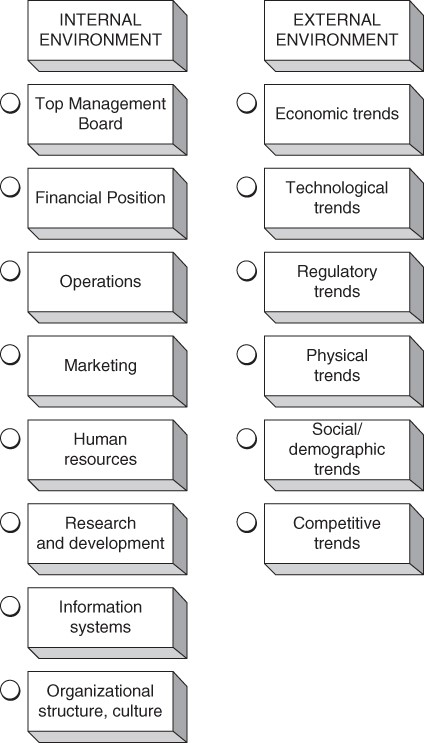
Internal strengths and weaknesses relate to issues that are within the organisation under the control of the management. A strength may lead to giving the organisation a competitive advantage over its competitors. A weakness is anything that may put the organisation at a disadvantage concerning the competitors or service users. The Church of God Scotland identified its strength as having highly skilled and qualified personnel on its board who have vast administration and financial management experience. And the Church seeks to leverage on this strength. The weakness, however, is the low liquidity level and fast increasing recurrent expenditure. However, weaknesses often makes the board to be alive to its responsibility by attaching importance to the strategic process. Interestingly, the method may eventually lead to identifying fears and clarifying goals. And this will help the organisation identify the strategic issues that need to be addressed to achieve the goals (Bryson, Ackerman and Eden, 2016).
External Environments (PESTLE))
The organisation takes the scan further to look at the external opportunities and potential threats. These are contained in the acronym PESTLE which stands for Political, Economic, Social, Technological, Legal and Environmental factors. They are developments that could have implications on the stakeholders.
Table 1.2 PESTLE Analysis
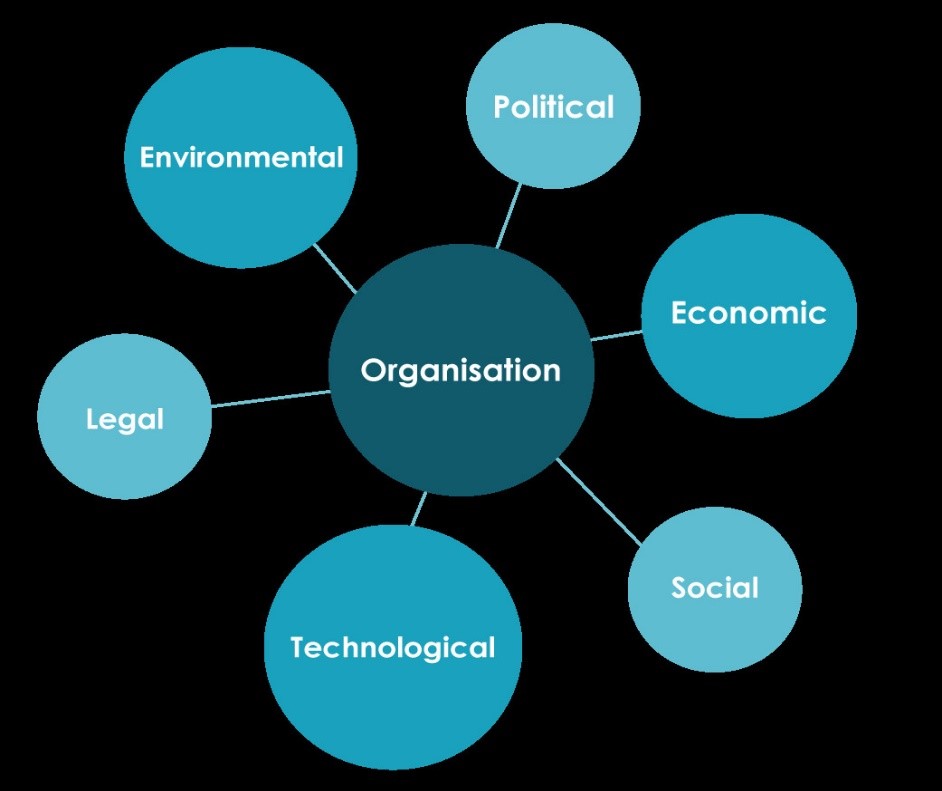
Environmental scan is performed within a framework of SWOT an ongoing exercise that can position the organisation better against any threat or risk (managwmwnthelp.org, 2015). As faith-based organisations depend largely on donations and philanthropy an unforeseen circumstance like COVID-19 with all its social and economic implication could affect the funding sources. PESTLE provides a big picture of the environment to the organisation. Strategic management is a process not just an exercise of a one-off long winding meeting. It is a growth philosophy that the organisation must imbibe. The increasing switch to a cashless society and online transactions for many businesses have caught some organisations unprepared due to lack of evolving in technology (Desai, 2020).
The lockdown measure to curb the spread of COVID-10 has made it difficult for some voluntary organisations to remain in operation because they are not tech-savvy. The organisation however should not be fixated on strategic planning as the only hope without seeking to know what are the hopes and concerns of other stakeholders like the customers or the target audience (Agranoff, 2012, and Bryson, et al., 2014).
Human Resource Management (HRM) and Organisational Outcome
The last couple of decades have witnessed scholars taking different positions towards understanding the relationship between Human Resource Management (HRM) and organisational outcomes (Bondarouk et al, 2016, Jiang, et al, 2012). Some argue that the relationships are not clear while some submit that it is statistically weak (Buller and McEvoy, 2012, Ogbonayya and Valizade, 2016). In the UK today, the voluntary sector is increasingly playing major role in the provision of welfare and delivering public services in partnership with the government, yet only few have paid adequate attention to HR practice (Hogg and Baines, 2011). It is also not clear if the few voluntary organisations that have embraced the HRM did so on their own volition or as a result of the influence of the government on their partnership. It is important to examine the effects of HRM system on both proximal organisational outcome like organisational commitment and distal organisational outcome like employee engagement and operational performance (Katou, 2017). Voluntary and faith-based organisations may be keen on enhancing the welfare of the community but whether they are willing to extend the gesture to their staff and volunteers is another thing. One of the key remits of HRM is managing changes and COVID 19 pandemic crisis with the “new normal” in the workplace has immensely brought that to the fore (Calvard, 2020). Human resource management helps an organisation to manage effectively the processes, policies and methods to harness the employee knowledge, skills, and abilities towards the organisational goals in pace with the changing needs and environments (Crumpton, 2015).
Strategy Implementation
Research has shown that strategic plan often fails not because of inadequate strategy formulation but because of insufficient strategy implementation ( Strategy implementation is putting the actual strategy into practice to meet organisational goals. It is the stage to gather and harmonise all the necessary and available resources together to bring the plan into fruition. It is the most complicated and complicated phase of strategic planning because it requires creating budgets, programmes and policies to meet the financial, human resources and operational goals (Al-Kandi, 2013). It is imperative that the management and other key players synergise to make the implementation successful (Maleka, 2014).
Strategy Evaluation
Strategy Monitoring is the final stage where the strategic plan is evaluated to determine if it yields the anticipated results in line with the organisational goals. It is a consistent to determine what areas of the plan to measure and the method of measuring the identified areas. It then compares the anticipated results with the actual ones. Strategy monitoring helps the organisation to adjust the plan to adapt to changing trends
Conclusion
From the study it is evident that strategy and Human Resources Management (HRM) have been found to be useful growth and sustainability tools in a voluntary, faith-based organisation. In light of the strategic planning principles, leadership has been found to play a significant role in successful implementation of strategic planning and consequently the performance of the organisation.
The study further concluded that the faith-based organisations are usually fixated on implementing a “divinely instructed” project. They are not keen to review the project even when is not producing desired results, whereas a little flexibility and periodical evaluation would have helped to save cost and maximise results.
See Appendix 1 for the Church of God Scotland 5 Year Strategic Plan
References
Agranoff, R. (2012). Collaborating to Manage. Washington, DC: Georgetown University Press.
Alvarez E A. (2013). PESTEL Framework: Volvo in Iraq. International G;lobal Management. ResearchGate.net p2.
Kok, M.S., Jones, M., Solomon-Moore, E. & Smith, J.R. (2018), “Implementation fidelity of a voluntary sector-led diabetes education programme”, Health Education, vol. 118, no. 1, pp. 62-81.
Baggott, R. (2013). Partnerships for Public Health and Well‐being. Policy and Practice. Palgrave Macmillan (New York)
Bathmutsky, E. (2013). Strategic Planning of a Local Church. D822 Course, Baptist Bible Seminary, Pennsylvania.
Bondarouk, T., Trullen, J. and Valverde, M. (2016), “Special issue of International Journal of Human Resource Management: conceptual and empirical discoveries in successful HRM implementation”, International Journal of Human Resource Management, Vol. 27 (8), pp. 906-908.
Bryson J.M. (2011). Strategic Planning for Public and Non-Profit Organizations- San Fransisco ,CA Jossey-Bass. (Google Scholar).
Belal, B and Abdullah, A, (2013). The Strategic Planning practices in Not for Profit Organisations in the Kingdom of Saudi Arabia. International Journal Social Enterpreneurship and Innovation Volume 13. 5.
Bruce, S. (2014). The secularization of Scotland. Journal of the study of the Christian Church
Bryson J.M., Edwards L.H, Van Slyke D.M. (2018), Getting Strategic About Strategic Planning Research. Public Management Review Volume 20-Issue 3.
Bryson, J.M. (2018). Strategic Planning for Public and Non Profit Organisations, 5th Edition, John Wiley and Sons Inc.
Bryson, J. M., Ackermann, F., and Eden, C. (2016). Discovering collaborative Advantage: The contributions of Goal Categories and Visual Strategy Mapping. Public Administration Review, 76 (6), 912–925.
Bryson, J. M., Crosby, B. C., and Bloomberg, L. (2014). Public Value Governance: Moving beyond traditional public administration and the new public management. Public Administration Review, 74(4), 445–456.
Buller, P.F. and McEvoy, G.M. (2012), “Strategy, human resource management and performance: Sharpening line on sight”, Human Resource Management Review, Volume 22 (1), pp.43-56
Campbell, D. (2011). Reconsidering the Implementation Strategy in Faith based Policy Initiatives. Non-Profit and Voluntary Sector Quarterly
Cavanagh, J., McNeil,N., and Bartram, T. (2013). The Australian Men’s Sheds Movement: Human Resources in a Voluntary Organisation. Asia Pacific Journal of Human Resources, 51, pp 292-306.10. 1111. Google Scholar.
Crumpton, M. A. (2016). Strategic Human Resource Planning for Academic Libraries: Information, Technology and Organization . 1st edition. Amsterdam, [Netherlands: Elsevier.
Desai, M. (2020). The Benefits of a Cashless Society. The World Economic Forum COVID Action Platform.
Deshpande A, and Tsai D. (2019). Managing a Mission-driven Franchise Organization: An Empirical Investigation of Organizational Practice and Individual Outcomes. Global Business Review. doi:10.1177/0972150918814102.
Fee, A and Gray, S.J. (2013). Transformational Learning Experience of International Development Volunteers in the Asia Pacific. The case of a multinational NGO. Journal of World Business , 48, 196-208. Google Scholar.
Guohui, S., and Eppier, M., (2010). Making Strategy Work: A Literature Review in the Factors influencing Strategy Implementation.
Hinton K.E. (2012). A Practical Guide to Strategic Planning in Higher Education. Societ. Google Scholar.y for College and Universisty Planning
Jager, U,P. (2010). Managing Social Businesses: Mission, Governance, Strategy and Accountability. Parlgrave Macmillan.
Jiang, K., Lepak, D.P., Hu, J. and Baer, J.C. (2012), “How does human resource management influence organisational outcomes? a meta-analytic investigation”, Academy of Management Journal, Vol. 55 (6), pp. 1264-1294.
Katou, A, A., (2017). How does Human Resource Management Influence Organisational Performance? An Integrative Approach-based Analysis. International Journal of Productivity and Performance Management. Volume: 66, (6). Pp 797-821 DOI: 10.1108/IJPPM-01-2016-000
Lassere. P. (2012). Analyzing Non Profit Organizations: Managerial Frameworks and Evaluation. Global Strategic Management, Palgrave, 3rd Edition ISBN 978-0-230-29381-6.
Macedo, I,M., Pinho, J,C., and Anabela, M. (2016). Revisiting the link between Mission Statement and Organisational Performance in the Non-Profit Sector. The Mediating Effect of Organisational Commitment. European Management Journal. Vol. 34, (1).
Ogbonnaya, C. and Valizade, D. (2016), “High Performance Work practices, Employee Outcomes and Organizational Performance: a 2-1-2 multilevel mediation analysis”, International Journal of Human Resource Management, Vol. 27 (16), pp. 1-21.
Pearce J.A, Robinson,J.B. (2009). Strategic Management: Formulation, Implementation Control. 10th Edition.
Placido, N., and Cecil, D. (2014). Implementing Best Practice for Needs Assessment and strategic Planning Systems: social Work and Faith Based Organisation Collaboration: A Case Study. Social Work and Christianity Botsford, Vol. 41 (1).
Maldonado Ramirez,A.D. (2011). Christianity and Burial in Late Iron Age Scotland, Ad400-650. PhD Thesis. University of Glasgow.
Maleka, S., (2014). Strategic Management and Strategic Planning. Conference DTPS Strategic Planning and Monitoring Volume 1. Pretoria.
Rezvani M,Gilaninia S & Mousavian S.J. (2011). Strategic Planning: A Tool for Managing Organizations in Competitive Environments. Australian Journal of Basic and Applied Sciences 5(9) 1537-1546.
Rigby, D and Bilodeau, B. (2015). Management Tools and Trend 2015. Bain and Company, London UK.
Sammut-Bonnici T, Galea D. (2015). PEST Analysis, Wiley Encyclopaedia of Management Vol.12. Strategic Management.
Spear, S. (2017). Impression Management Activity in Vision, Mission and Values Statements: A Comparison of Commercial and Charitable Organisations.International Studies of Management and Organisations. Vol. 47 (2). pp 159-175.
The Holy Bible Proverbs 21.5
The Holy Bible Luke 14.28.
Zietlow, J., Hanklin,J, A., Seidner, O and O’Brien, T. (2018). Financial Managements for Non-Profit Organisations. Wiley. ISBN: 9781119382560.
.
A 5 – Year Strategic Plan for Church of God Scotland 2018-2023. As of 2020
CHURCH
OF “for all people and all ages”
GOD
SCOTLAND
Appendix 1
Introduction
This blog aims to investigate the Church of God Scotland’s growth plan designed to attach importance to strategy and Human Resources Management (HRM) as sustainability tools in a voluntary, faith-based organisation (Cavanagh et al., 2013; Fee & Gray, 2013). By definition voluntary, faith-based organisations include churches and other para-church bodies that provide critical human and spiritual services (Placido and Cecil, 2014). The report reviews the Church’s five-year strategic plan, which is aimed to be the most diverse Church in Scotland by 2023.
Mission Statement
The mission of the Church of God Scotland is to proclaim the gospel of Jesus Christ in the power of the Spirit and with the love of God. This is the purpose of the church which captures its uniqueness and identity (Macedo, et al, 2016, Rigby and Bilodeau, 2015).
Vision Statement
The vision of the church was to be the most diverse church in Scotland by the year 2023 with branches across all the cities in Scotland. A vision statement communicates the future where an organisation seeks to go and what the future scope will be (Crumpton, 2016). The vision is usually broad that no organisation can realise the vision by itself so it involves a large number of stakeholders (Bakhmutsy, 2013).
Strategic Objectives
The strategic objectives of the church to realise its vision is by placing a premium emphasis on strategy and human resource management. The objectives serve as the priorities of the church and they are not just a one-off exercise but a process which is to be reviewed from time to time. The church has recognised the importance of strategic objectives as the drivers to convert the mission into actionable plans (Bakhmutsky, 2013). The church also recognised that lack of strategy could make its vision and the mission drift due to the ever-changing demands of the donors who are the source of funding for the organisation (Al-Omaria and Aljawarneha, 2019).
The competitive advantage of the church is youth oriented programme, contemporary music and the appeal to genz folks who are computer savy
STRATEGY AND THE “BOTTOM LINE”. Historically, nonprofit organizations have not considered themselves to have a “bottom line.” They seem to consider everything they do to be righteous and to serve a cause, and so they are not willing to insist that if a program does not produce results, then perhaps resources should be redirected. Nonprofits need the discipline of organized abandonment and the critical choices that are involved. Organized abandonment involves a carefully planned reevaluation of programs and activities, with a pruning process applied to certain of those programs in order to free up resources for reapplication. Later in the chapter we provide a tool to guide these organized abandonment decisions.
Stakeholders
The stakeholders are the Trustees, the Executive Council, the Ministerial team, the Staff and Volunteers, the Church Members, the Charity Commission (OSCR), the Funders, HRMC, and the Scottish Government and the General Public.
Strategic Plan
Staff and Volunteer Development
- To hire human resource experts as part of staff team by November, 2020
- To outsource hiring of staff especially non-ministerial staff to HR outfits
- To hire staff who are also skilled in playing musical instrument
- To build a hub of volunteers to be trained and resourced by 2021.
2.. Leadership Development
- .Provide a new leadership training curriculum relevant to Scotland by 31 January,2021
- Train 20 new Small Group leaders in level One by 31 March,2021
- Provide a one per quarter Level One leadership training annually
- Provide at least two Level Two leadership training annually.
- Provide at least two Level Three leadership trainings annually.
- Establish Believers Classes Christianity 101 Classes for new converts every Monday
3. Financial Security and Management System
- 3.1. To set up a standard financial management system
- 3.2. To develop an accurate 2019/2020 budget that must be followed and monitored
- 3.3. Increase Church savings by 20% every year
- 3.4 To vote 10% of the church budget towards evangelism by the end of the year.
- 3.5 To increase annual location for Continuing Professional Development (CPD)
- 3.6 Purchasing and Establishing a database management system.
4. Community Outreach
- Organise a quarterly rally and evangelism outreach in city centres from June 2019
- Attend University open days to meet and assist new arrivals.
- Organise a welcome party for new University and college intake.
- Organise a summer barbecue gathering and sports day for youths and families.
- Establishing distribution of monthly newsletter and fliers to University campuses.
- . Music training classes to be organized for youths by January 2022..
- Bible reciting competition to be organized for youths by March 2022.
| COMPREHENSIVE STRATEGIC PLANS |
1. Staff and volunteer Development Measure % Target 100%
1. Have each Pastor and staff attend best practice conference annually 2 Continuing Professional Development mandatory for all ministers and staff
| Team Goals (Leadership/Pastoral Team) | Measure | Target | Start date End date |
| To hire HR expert on staff list | %complete | 100% | 01/11/19 30/12/19 |
| Hire staff skilled in playing musical instrument | %complete | 100% | 01/11.19 30/11/19 |
| Build a hub of adequately resourced volunteers | %complete | 100% | 01/10/19 30/11/19 |
2. Leadership Development: Create a leadership culture
2.1 New Scotland compliant leadership training manual by Measure: 20 trained Target 20
31/06/21 (Director of Education)
| Team Goals (Director of Education) | Measure | Target | Start date End date |
| Provide a quarterly Level 1 training annually | % complete | 100% | 01/03/19 30/11/20 |
| Provide 2 Level 2 training annually | % complete | 90% | 01/06/19 30/11/20 |
| Provide 1 Level 3 training annually | % complete | 90% | 01/09/19 30/11/20 |
Financial Security and management system Measure % Target 100%
6.1 To develop an accurate 2018/2019 to follow Measure Budget Target 100% completed
| Team Goals (Finance/Administration Team) | Measure | Target | Start date End date |
| Update & analyse 2017/2018 budget for benchmarks | %complete | 100% | 1/10/20 1/11/21 |
| Increase savings by 20% through cutting costs | %complete | 95% | 1/04/20 30/12/21 |
4. Care Ministry (Poverty alleviation and Pastoral care). Measure: % Target 95%
4.1 “People do not care how much you know but how much you care .”
| Team Goals (Welfare board) | Measure | Target | Start date End date |
| Establish a food bank project | %complete | 100% | 01/02/18 30/11/19 |
| Establish a welfare fund for struggling families | %cpmplete | 100% | 01/03/18 30/11/19 |
| Organise a monthly visit to elderly in care homes | %complete | 100% | 01/11/19 |
10. Community Outreach Measure % Target 100%
10.1 Taking the church to community by reaching people of all ages.
| Team Goals (Mission and outreach Pastor) | Measure | Target | Start date End date |
| Organise a quarterly rally and evangelism outreach in city centres from June 2019 | %complete | 100% | 01/06/20 24/12/21 |
| Attend University open days to meet/assist new arrivals | %complete | 100% | 08/09/20 15/09/21 |
| Organise welcome party for new University intakes | %complete | 100% | 28/09/20 28/09/21 |
| Organise a summer barbecue gathering and sports day for youths and families. | %complete | 100% | 20/07/20 20/07/21 |
https://www.ageuk.org.uk/scotland. And the church population is declining due to the elderly who constitute greater number of church goers in Scotland. https://www.bbc.co.uk/news/uk-scotland-39613631. Church of God Scotland aims to address this problem by making intentional effort towards reaching the young people and middle aged without necessarily neglecting the elderly
 Having a Sound Mind